
Turning a product idea into a working electronic device takes more than designing a circuit board. It requires a clear understanding of the application, the right electronic architecture, hardware and firmware development, prototype testing, and a reliable path toward manufacturing.
For startups, equipment manufacturers, and businesses developing new products, working with an experienced electronics development partner can make this process more manageable.
At MaxMait, we support custom electronics development, helping customers move from initial requirements to engineering designs, prototypes, and manufacturing coordination.
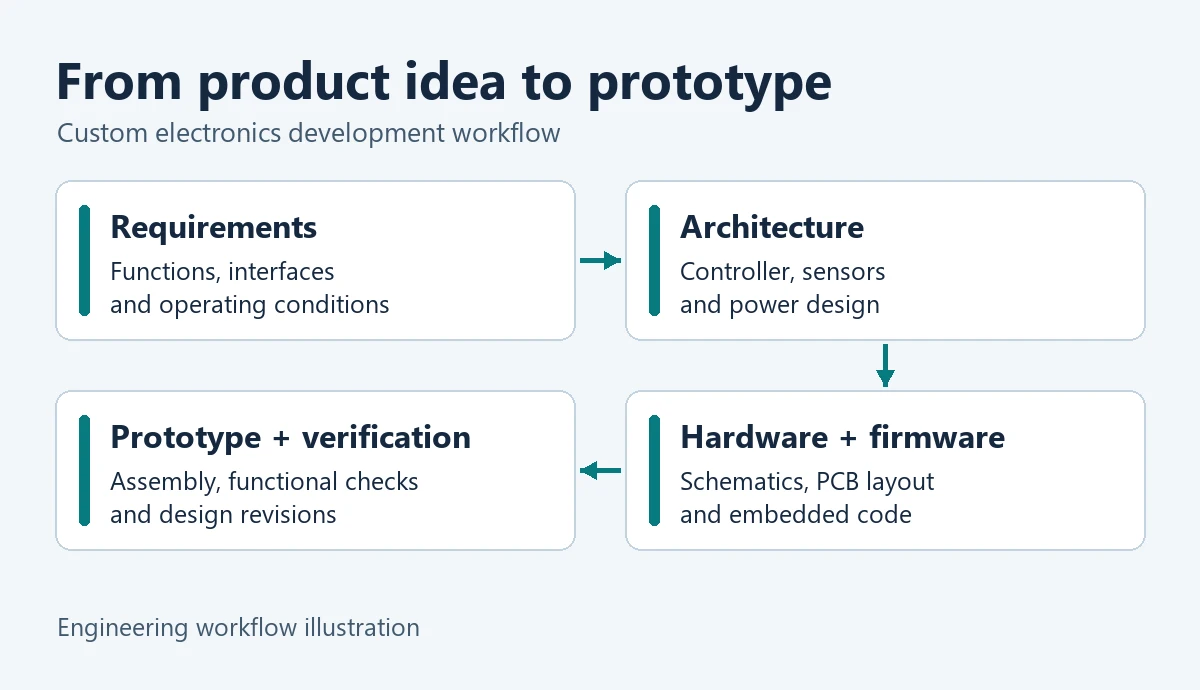
1. Understanding the Product Requirements
Every successful development project starts with understanding what the product needs to do.
Before beginning circuit design, it is important to identify:
- The product’s intended application
- Required functions and operating conditions
- Input and output interfaces
- Communication requirements
- Power supply and electrical constraints
- Environmental and reliability requirements
- Target production volume and budget
A clear technical requirement helps reduce unnecessary design changes and provides a foundation for the development process.
2. Developing the Electronic Solution
Once the requirements are understood, the next step is to develop an appropriate electronic architecture.
Depending on the application, this may include:
- Microcontroller-based control systems
- Sensor interfaces and signal conditioning
- Motor control circuits
- Relay and power management circuits
- RS485, CAN, and other industrial communication interfaces
- Embedded firmware and control logic
The objective is to select a practical solution that meets the product’s functional requirements while considering development cost, component availability, and future manufacturing needs.
3. PCB Design and Hardware Development
The electronic architecture is translated into circuit schematics and PCB layouts.
Important considerations include:
- Component selection and electrical compatibility
- Power distribution and grounding
- Signal integrity and noise management
- Thermal considerations
- PCB size and mechanical integration
- Design for manufacturing and assembly
PCB design should consider the actual application, selected components, manufacturing capabilities, and expected operating conditions.
A well-designed PCB provides a stronger foundation for prototype development and subsequent testing.
4. Embedded Firmware Development
For products that require programmable control, hardware development must work together with embedded software.
Firmware development may include:
- Sensor data acquisition
- Motor and actuator control
- Communication protocols
- Relay and output control
- Fault detection and protection logic
- System configuration and diagnostics
Hardware and firmware should be developed with the overall product requirements in mind rather than treated as separate tasks.
5. Prototype Manufacturing and Testing
After the design is prepared, the next step is to build a prototype.
A typical prototype process includes:
- Preparing the PCB manufacturing files and bill of materials.
- Coordinating PCB fabrication and component sourcing.
- Arranging PCB assembly.
- Loading firmware and configuring the prototype.
- Performing functional checks against agreed requirements.
- Recording issues and preparing design revisions when necessary.
Prototype testing helps identify design problems before moving toward larger production quantities.
Actual test results should be documented against defined test conditions and acceptance criteria.
6. From Prototype to Manufacturing
A successful prototype is an important milestone, but it does not automatically mean the product is ready for mass production.
Before production, the design may require:
- Design revisions based on prototype results
- Component availability reviews
- Manufacturing and assembly reviews
- Test procedure development
- Cost and production planning
- Quality and acceptance criteria
MaxMait can help coordinate engineering and manufacturing resources in China, supporting customers as they move from prototype development toward small-batch production.
7. Working with MaxMait
MaxMait focuses on custom electronics design and development, with engineering and manufacturing support in China.
Our areas of work include:
- Custom PCB design
- Electronic controller development
- Embedded hardware and firmware
- Industrial communication interfaces
- Motor control electronics
- Prototype and PCBA coordination
- Small-batch manufacturing support
We work with customers to understand their product requirements, evaluate technical options, and develop practical solutions.
Whether you are developing a new electronic product, upgrading an existing controller, or looking for engineering support for a specific project, the first step is to discuss your requirements.
Start a Conversation About Your Project
Do you have an electronic product idea or an existing device that needs a custom control solution?
Contact MaxMait to discuss your application, technical requirements, and potential development approach.
MaxMait — Custom Electronics Design & Development.
From concept to prototype, with manufacturing support in China.